
What Mental Load Mentoring Actually Looks Like
You might not have met a Mental Load Mentor before, or really know what it’s all about. So in this blog post I’m sharing what the first week with my mentee Jess* looked like, so you can get a feel for how it works.
*Sharing with full permission, but I've changed her name on request
The Starting Point
When Jess and I first spoke, she was in a period of her life that was very full.
She had 2 young children (almost 4 and almost 1) and she was going back to work after maternity leave in about a month’s time. It also happened to be the month of both her kids’, and her husband’s birthdays.
They lived in a 2-bedroom flat, where – as is to be expected with small kids in tow - stuff had slowly crept into every corner.
Nothing was falling apart, but she also didn’t feel fully on top of everything.
She signed up to Mental Load Mentoring with me feeling hopeful, but also a bit apprehensive.
Like a lot of people, she liked the idea of support, but wasn’t totally sure how it would actually work in practice.
What is it?
Mental Load Mentoring is a 6-week package of 1-on-1 WhatsApp support with me.
My mentees are free to message me anytime (even in the middle of the night) and I commit to getting back to them during set times throughout the week - although I typically reply more often.
We can exchange written messages, voice notes, photos and videos - whatever suits them best.
We don’t chat “live” or on video calls or anything like that on purpose, so that it fits around real life. They are free to message me on the loo, while waiting for the kettle to boil or any other time that works.
Day 1: Birthday Overwhelm
On Day 1, I sent her a WhatsApp to say hi and invited her to share whatever was on her mind. I had already let her know that if she felt stuck knowing where to start, I would take the lead.
I knew that her energy and capacity would vary from day-to-day and week-to-week (as it does for all of us), so part of my role was to read the mood and adapt accordingly.
Instead of starting with a big plan, we started with the thing that was really bothering her that morning: birthday overwhelm.
So we focussed straight away on simplifying the plans.
She took a photo of the to-do list she’d written in her notebook and sent it to me. I gently challenged if she really needed or wanted to do all of the things on the list, and made suggestions on things she could drop or simplify.
Her response is my favourite accolade ever:

She settled on:
Fewer cakes (she had planned separate baby/adult cakes) and asking her sister to make one of them
The same food across all 3 celebrations
Booking the cleaner before the first party
Deciding against getting her kids to make a handmade present for their dad
You might read those and think they sound obvious. But when you're in the thick of it, honestly nothing is obvious!
On Day 1, she went from: “I’m slightly overwhelmed by planning it all” to:

Without disrupting her day's schedule of a baby class, naps, meals, snacks and normal day-to-day life.
At the end of Day 1, this is how she was feeling:

Day 2-7: Focus on Home
One thing Jess knew from the start that she wanted help with, was to declutter her flat and make home life run more smoothly.
So, on Day 2, I asked Jess if she’d like to share a quick video of her home, so that I could really understand the challenges and give really specific suggestions.
(I know it can feel uncomfortable sharing your home unfiltered like this, but I will never judge you for having a messy home. I know firsthand what it’s like juggling kids and home - no explanation needed!)
She was happy to do so, and sent me a couple of recordings, pointing out the things she found annoying and explaining how each space was used as she went.
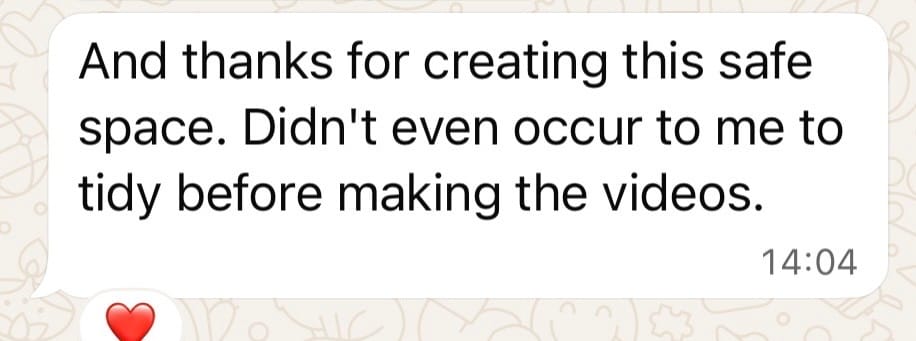
It was so helpful for me to see, so that I could share really specific ideas that might help.
Her video uncovered 2 things:
1) too much stuff in certain hotspots of her home and
2) areas that just weren’t working for her family
So I worked out a plan of small, manageable steps she could take as and when she had the time and inclination.
I didn’t share them all at once (that would have been overwhelming). Instead, I drip-fed ideas gradually, suggesting one or two manageable things at a time, based on what she realistically had the energy for that day.
Things like:
booking a trip to the recycling centre to get rid of the lamps and airer they no longer needed
arranging for her friend to collect the nappies their daughter had grown out of
making space for the hoover in the hallway cupboard, rather than in the kitchen where the hose kept getting in the way
putting a pretty bowl in the entrance to keep keys and wallets tidy and easy-to-find
She sent me updates and showed me pictures of her progress which I met with celebratory emojis ❤🥳🙌

Little by little, she was chipping away at what had felt like a mammoth task. From those first steps, we were building momentum, and she was seeing the impact. Not only in how her home looked, but also in how her mind felt clearer and her day calmer.
Getting out the door was less stressful because the door wasn't bouncing back in her face due to all the coats hanging on the other side of it. She was able to find the kids' gloves and hats quickly because they had a specific spot (that the big one could reach independently).
The changes she really needed were finally happening!
Weeks 2-6
The following 5 weeks continued in a similar vein. We covered things like routines, storage, birthdays, life admin, returning to work and juggling life with 2 young kids.
Some days Jess came to me with burning questions. Other days, she was tired out, or simply looking for ideas she might not have considered before - so I would take the lead and gently suggest things for her to come back to when it suited her.
As well as loads of practical things, we also talked about perspective, and about setting realistic expectations for the reality of life as it is right now. Those shifts can be just as impactful as getting rid of all the coats you no longer wear.

Is Mental Load Mentoring for You?
If you’re reading this, there’s a strong chance it is. The fact that you’re here tells me that something is off for you at the moment.
Maybe you’re feeling on the verge of burnout, or have a niggling feeling that you’re not living your best life right now. That there are so many things that NEED doing and not enough time or headspace to do them all, nor for the things you actually WANT to do.
Or maybe you just want someone to share the load with, in a way that doesn’t need explaining or come with emotional baggage.
The conversations will look different for everyone.
For Jess, decluttering and simplifying home life were big themes, but your Mental Load Mentoring might not involve decluttering at all. Anything that feels heavy, frustrating or mentally draining can be in the mix.
It could be 1 big thing or 100s of small things. You might already know exactly what you want my help with, or we might figure that out together along the way.
You can find example topics and questions we can cover here.
Is it worth it?
I’ll leave you with a few more messages I received from Jess during our 6 weeks, as her words say it better than I could:




“Can definitely see myself joining another mentoring session when I’m back in the swing of things.”
If you’re carrying a lot and wishing everyday life felt a bit lighter, you can find out more about Mental Load Mentoring here⬇
Join my email list for practical tips to lighten your mental load, get life admin and chores done fast, and validation on the particularly juggly days.
By clicking this button, you give permission for me to send you emails. You can unsubscribe at any time.


Copyright © 2025 A Life Less Complicated